
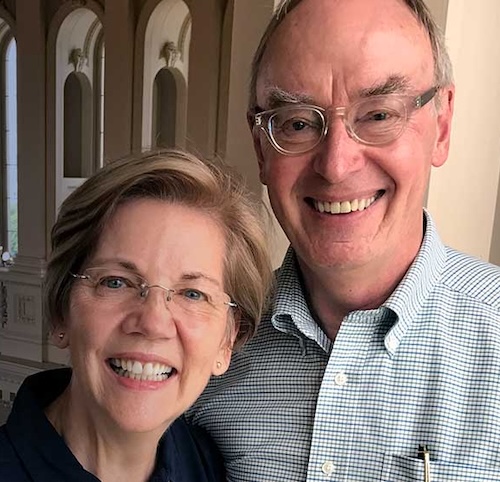
Elizabeth Ann Warren (Herring; born June 22, 1949) is an American politician and former law professor who is the senior United States senator from the state of Massachusetts serving since 2013. A member of the Democratic Party and regarded as a progressive. Warren has focused on consumer protection equitable economic opportunity and the social safety net while in the Senate. Warren was a candidate in the 2020 Democratic Party presidential primaries ultimately finishing third after Joe Biden and Bernie Sanders.
Born and raised in Oklahoma Warren is a graduate of the University of Houston and Rutgers Law School. She has taught law at several universities including the University of Houston the University of Texas at Austin the University of Pennsylvania and Harvard University with expertise in bankruptcy and commercial law. Warren has written 12 books and more than 100 articles.
Warren’s first foray into public policy began in 1995 when she worked to oppose what eventually became a 2005 act restricting bankruptcy access for individuals. During the late 2000s her national profile grew after her forceful public stances in favor of more stringent banking regulations after the 2008 financial crisis. She served as chair of the Congressional Oversight Panel of the Troubled Asset Relief Program and proposed and established the Consumer Financial Protection Bureau for which she served as the first special advisor under President Barack Obama.
In 2012 Warren defeated incumbent Republican Scott Brown and became the first female U.S. senator from Massachusetts. She was reelected by a wide margin in 2018 defeating Republican nominee Geoff Diehl. On February 9 2019 Warren announced her candidacyin the 2020 United States presidential election.
She was briefly considered the front-runner for the Democratic nomination in late 2019 but support for her campaign dwindled. She withdrew from the race on March 5 2020 after Super Tuesday.
She was reelected to a third Senate term in 2024 against Republican nominee John Deaton.
Early life and education
Warren is the fourth child of Pauline Louise (Reed, 1912–1995) a homemaker and Donald Jones Herring (1911–1997) a U.S. Army flight instructor during World War II both of whom were members of the evangelical branch of the Protestant Methodist Church. Warren has described her early family life as teetering “on the ragged edge of the middle class” and “kind of hanging on at the edges by our fingernails.”
She and her three older brothers were raised Methodist.Warren lived in Norman Oklahoma until she was 11 years old when her family moved back to Oklahoma City.
When she was 12 her father then a salesman at Montgomery Ward had a heart attack which led to many medical bills as well as a pay cut because he could not do his previous work. After leaving his sales job he worked as a maintenance man for an apartment building. Eventually the family’s car was repossessed because they failed to make loan payments. To help the family finances her mother found work in the catalog-order department at Sears. When she was 13 Warren started waiting tables at her aunt’s restaurant.
Warren became a star member of the debate team at Northwest Classen High School and won the state high school debating championship. She also won a debate scholarship to George Washington University (GWU) at the age of 16.
She initially aspired to be a teacher, but left GWU after two years in 1968 to marry James Robert “Jim” Warren, whom she had met in high school. Warren and her husband moved to Houston, where he was employed by IBM. She enrolled in the University of Houston and graduated in 1970 with a Bachelor of Science degree in speech pathology and audiology. The Warrens moved to New Jersey when Jim received a job transfer. She soon became pregnant and decided to stay at home to care for their daughter, Amelia.
After Amelia turned two, Warren enrolled at Rutgers Law School. She received her Juris Doctor in 1976 and passed the bar examination shortly thereafter. Shortly before graduating, Warren became pregnant with their second child, Alexander.
Career
In 1970, after obtaining a degree in speech pathology and audiology, but before enrolling in law school, Warren taught children with disabilities for a year in a public school. During law school, she worked as a summer associate at Cadwalader, Wickersham & Taft. After receiving her Juris Doctorand passing the bar examination, Warren offered legal services from home, writing wills and doing real estate closings.
In the late 1970s, 1980s, and 1990s, Warren taught law at several American universities while researching issues related to bankruptcy and middle-class personal finance. She became involved with public work in bankruptcy regulation and consumer protection in the mid-1990s.
Academics
Warren began her career in academia as a lecturer at Rutgers University, Newark School of Law (1977–1978). She then moved to the University of Houston Law Center (1978–1983), where she became an associate dean in 1980 and obtained tenure in 1981. She taught at the University of Texas School of Law as visiting associate professor in 1981 and returned as a full professor two years later (staying from 1983 to 1987). She was a research associate at the Population Research Center of the University of Texas at Austin from 1983 to 1987 and was also a visiting professor at the University of Michigan in 1985.
During this period, Warren also taught Sunday school. Warren in University of Texas School of Law’s 1987 yearbook Warren’s earliest academic work was heavily influenced by the law and economics movement, which aimed to apply neoclassical economic theory to the study of law with an emphasis on economic efficiency. One of her articles, published in 1980 in the Notre Dame Law Review, argued that public utilities were over-regulated and that automatic utility rate increases should be instituted.
But Warren soon became a proponent of on-the-ground research into how people respond to laws. Her work analyzing court records and interviewing judges, lawyers, and debtors, established her as a rising star in the field of bankruptcy law.
According to Warren and economists who follow her work, one of her key insights was that rising bankruptcy rates were caused not by profligate consumer spending but by middle-class families’ attempts to buy homes in good school districts.
Warren worked in this field alongside colleagues Teresa A. Sullivan and Jay Westbrook, and the trio published their research in the book As We Forgive Our Debtors in 1989. Warren later recalled that she had begun her research believing that most people filing for bankruptcy were either working the system or had been irresponsible in incurring debts, but that she concluded that such abuse was in fact rare and that the legal framework for bankruptcy was poorly designed, describing the way the research challenged her fundamental beliefs as “worse than disillusionment” and “like being shocked at a deep-down level”.
In 2004, she published an article in the Washington University Law Review in which she argued that correlating middle-class struggles with over-consumption was a fallacy. Warren joined the University of Pennsylvania Law School as a full professor in 1987 and obtained an endowed chair in 1990, becoming the William A. Schnader Professor of Commercial Law.
In 1992, she taught for a year at Harvard Law School as the Robert Braucher Visiting Professor of Commercial Law. In 1995, Warren left Penn to become Leo Gottlieb Professor of Law at Harvard Law School. In 1996, she became the highest-paid professor at Harvard University who was not an administrator, with a $181,300 salary and total compensation of $291,876, including moving expenses and an allowance in lieu of benefits contributions.
As of 2011, she was Harvard’s only tenured law professor who had attended law school at an American public university. Warren was a highly influential law professor. She published in many fields, but her expertise was in bankruptcy and commercial law. From 2005 to 2009, Warren was among the three most-cited scholars in those fields.
Warren began to rise in prominence in 2004 with an appearance on the Dr. Phil show, and published several books including The Two-Income Trap.
Advisory roles
In 1995, the National Bankruptcy Review Commission’s chair, former congressman Mike Synar, asked Warren to advise the commission. Synar had been a debate opponent of Warren’s during their school years. She helped draft the commission’s report and worked for several years to oppose legislation intended to severely restrict consumers’ right to file for bankruptcy. Warren and others opposing the legislation were not successful; in 2005, Congress passed the Bankruptcy Abuse Prevention and Consumer Protection Act of 2005, which curtailed consumers’ ability to file for bankruptcy.
From 2006 to 2010, Warren was a member of the FDIC (Federal Deposit Insurance Corporation) Advisory Committee on Economic Inclusion. She is a member of the National Bankruptcy Conference, an independent organization that advises the U.S. Congress on bankruptcy law, a former vice president of the American Law Institute and a member of the American Academy of Arts and Sciences. Warren’s scholarship and public advocacy were the impetus for establishing the Consumer Financial Protection Bureau in 2011.